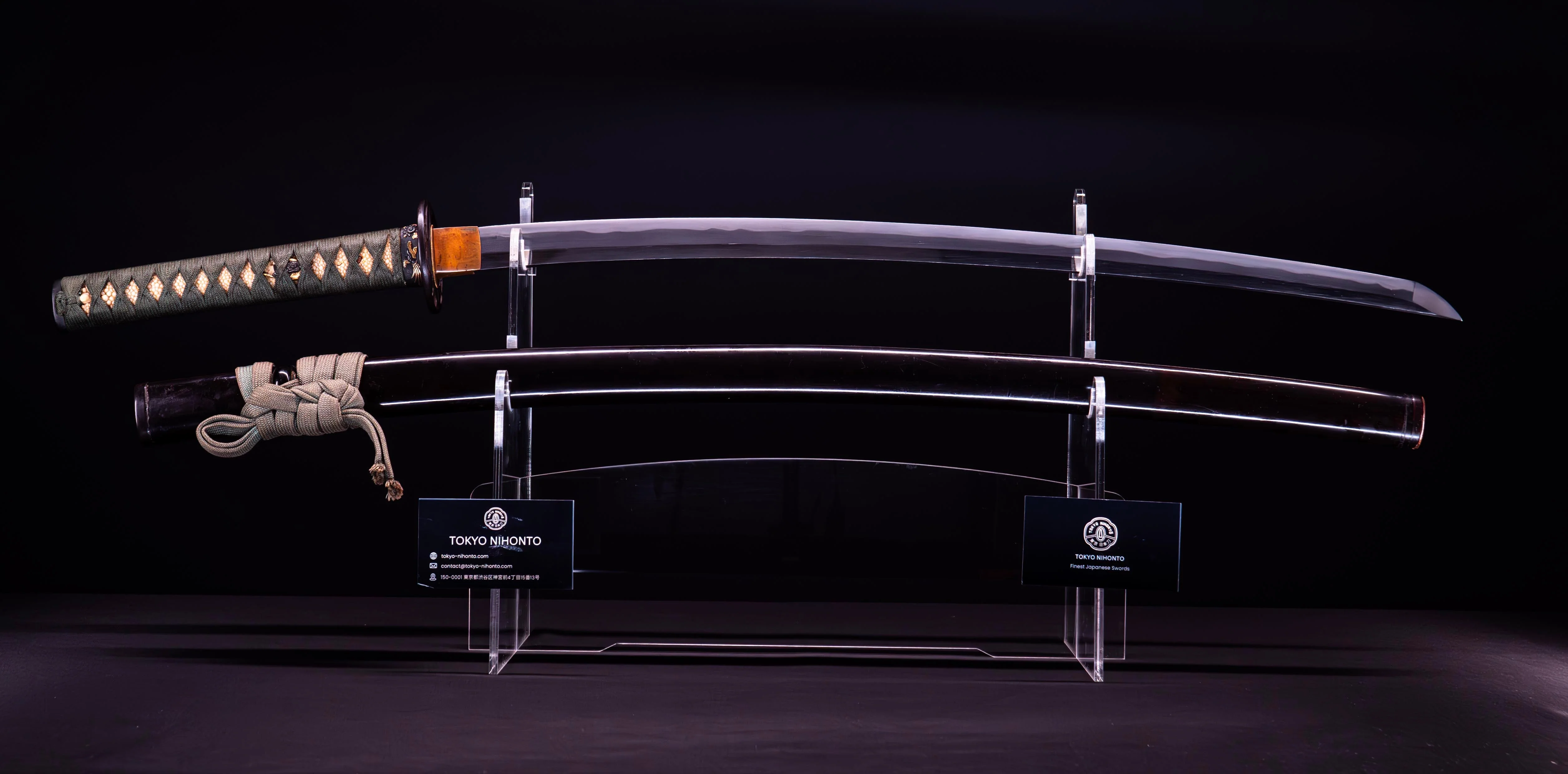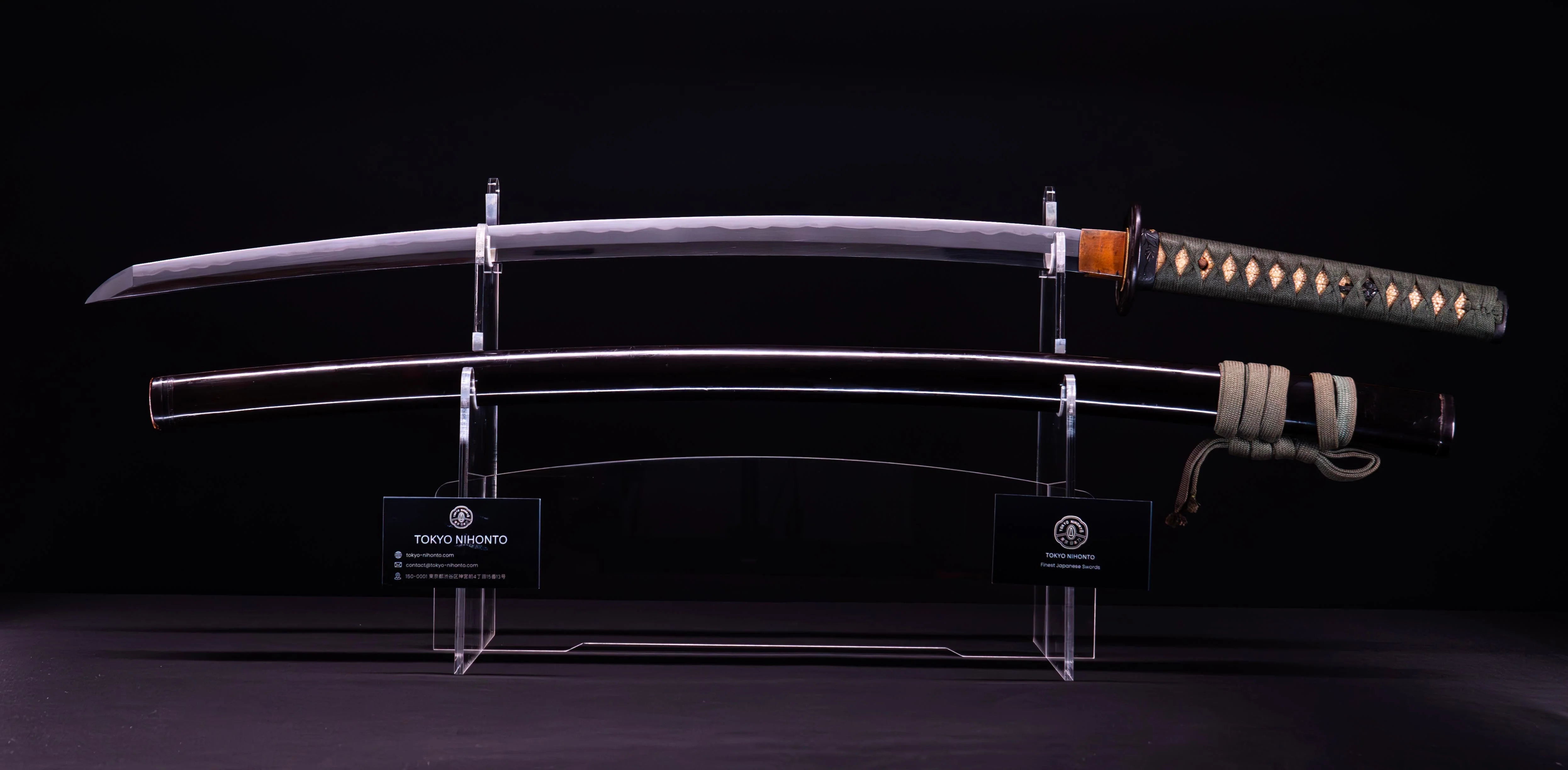
Antique Japanese Sword Katana Naminohira Sadaku
- Mei (Signature): 波平貞偶 (Naminohira Sadaku)
- Type: Katana
- Period : late Muromachi
- With BO-HI
- Blade Length: 63.4 cm
- Curvature (Sori): 0.9 cm
- Width at the Kissaki: 39mm
- Motohaba (Width at the base): 28.5mm
- Motokasane (Thickness at the base): 7mm
- Blade's Total Length: 81.4 cm
- Total Sheath (Saya) Length: 89.5 cm
- Blade Weight: 531g
- Total Weight (including sheath): 872g
Description:
The blade presents a signature of Naminohira Sadaku, a smith from the late Muromachi period, around the Eisho era. The ji-hada (texture of the blade's surface) displays a beautifully crafted masame-hada, which resembles straight grain patterns. The steel's texture (jigane) has a refined quality, demonstrating a well-forged luminous foundation.
The hamon (temper pattern) reveals a straight pattern (suguha) with a shallow wave (notare), which is subtly interspersed with small irregularities (ko-midare). The boshi (temper line in the tip or kissaki area) appears to be in a swept manner (hakikake) with a slight turn-back.
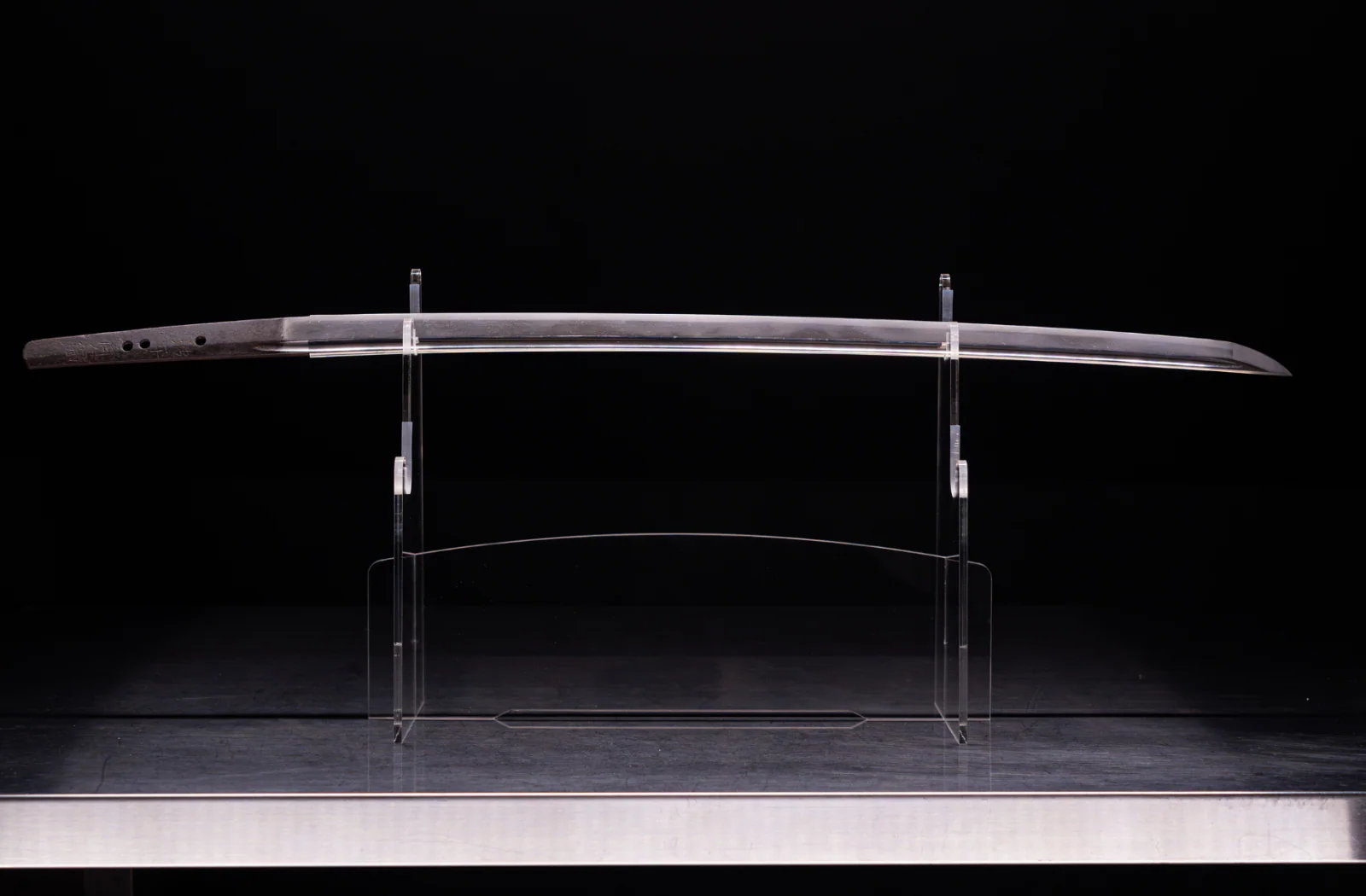
The nakago (tang) appears to be polished (mune is polished), with three mekugi-ana (peg holes). The yasurime (file marks on the tang) are in a slanting pattern, known as sujikai.
The blade seems to be in an old polish but is still in a condition appreciable for collectors. The sword comes with a white saya (sheath), which bears an inscription, likely referring to its attribution to the Eisho era during the late Muromachi period.
Historical Context:
The Naminohira school, originating from the Satsuma province, has a history that spans several centuries. While not as renowned as the major sword-making traditions like Bizen or Soshu, the Naminohira smiths produced a significant number of quality swords, especially during the Kamakura and Muromachi periods.
Naminohira Sadaku would have been one of the smiths from this school, producing blades during the tumultuous late Muromachi period, a time of significant warfare and social upheaval in Japan. The period is marked by the rise of powerful daimyo (feudal lords) who would later set the stage for the unification of Japan.
Owning a sword from this era, especially one in good condition, provides a tangible link to a time when samurai values and martial skills were of paramount importance in Japanese society.
- Mei (Signature): 波平貞偶 (Naminohira Sadaku)
- Type: Katana
- Period : late Muromachi
- With BO-HI
- Blade Length: 63.4 cm
- Curvature (Sori): 0.9 cm
- Width at the Kissaki: 39mm
- Motohaba (Width at the base): 28.5mm
- Motokasane (Thickness at the base): 7mm
- Blade's Total Length: 81.4 cm
- Total Sheath (Saya) Length: 89.5 cm
- Blade Weight: 531g
- Total Weight (including sheath): 872g
Description:
The blade presents a signature of Naminohira Sadaku, a smith from the late Muromachi period, around the Eisho era. The ji-hada (texture of the blade's surface) displays a beautifully crafted masame-hada, which resembles straight grain patterns. The steel's texture (jigane) has a refined quality, demonstrating a well-forged luminous foundation.
The hamon (temper pattern) reveals a straight pattern (suguha) with a shallow wave (notare), which is subtly interspersed with small irregularities (ko-midare). The boshi (temper line in the tip or kissaki area) appears to be in a swept manner (hakikake) with a slight turn-back.
The nakago (tang) appears to be polished (mune is polished), with three mekugi-ana (peg holes). The yasurime (file marks on the tang) are in a slanting pattern, known as sujikai.
The blade seems to be in an old polish but is still in a condition appreciable for collectors. The sword comes with a white saya (sheath), which bears an inscription, likely referring to its attribution to the Eisho era during the late Muromachi period.
Historical Context:
The Naminohira school, originating from the Satsuma province, has a history that spans several centuries. While not as renowned as the major sword-making traditions like Bizen or Soshu, the Naminohira smiths produced a significant number of quality swords, especially during the Kamakura and Muromachi periods.
Naminohira Sadaku would have been one of the smiths from this school, producing blades during the tumultuous late Muromachi period, a time of significant warfare and social upheaval in Japan. The period is marked by the rise of powerful daimyo (feudal lords) who would later set the stage for the unification of Japan.
Owning a sword from this era, especially one in good condition, provides a tangible link to a time when samurai values and martial skills were of paramount importance in Japanese society.
Description
- Mei (Signature): 波平貞偶 (Naminohira Sadaku)
- Type: Katana
- Period : late Muromachi
- With BO-HI
- Blade Length: 63.4 cm
- Curvature (Sori): 0.9 cm
- Width at the Kissaki: 39mm
- Motohaba (Width at the base): 28.5mm
- Motokasane (Thickness at the base): 7mm
- Blade's Total Length: 81.4 cm
- Total Sheath (Saya) Length: 89.5 cm
- Blade Weight: 531g
- Total Weight (including sheath): 872g
Description:
The blade presents a signature of Naminohira Sadaku, a smith from the late Muromachi period, around the Eisho era. The ji-hada (texture of the blade's surface) displays a beautifully crafted masame-hada, which resembles straight grain patterns. The steel's texture (jigane) has a refined quality, demonstrating a well-forged luminous foundation.
The hamon (temper pattern) reveals a straight pattern (suguha) with a shallow wave (notare), which is subtly interspersed with small irregularities (ko-midare). The boshi (temper line in the tip or kissaki area) appears to be in a swept manner (hakikake) with a slight turn-back.
The nakago (tang) appears to be polished (mune is polished), with three mekugi-ana (peg holes). The yasurime (file marks on the tang) are in a slanting pattern, known as sujikai.
The blade seems to be in an old polish but is still in a condition appreciable for collectors. The sword comes with a white saya (sheath), which bears an inscription, likely referring to its attribution to the Eisho era during the late Muromachi period.
Historical Context:
The Naminohira school, originating from the Satsuma province, has a history that spans several centuries. While not as renowned as the major sword-making traditions like Bizen or Soshu, the Naminohira smiths produced a significant number of quality swords, especially during the Kamakura and Muromachi periods.
Naminohira Sadaku would have been one of the smiths from this school, producing blades during the tumultuous late Muromachi period, a time of significant warfare and social upheaval in Japan. The period is marked by the rise of powerful daimyo (feudal lords) who would later set the stage for the unification of Japan.
Owning a sword from this era, especially one in good condition, provides a tangible link to a time when samurai values and martial skills were of paramount importance in Japanese society.